

FICTIONAL FEATURE · A NIGHT ON THE WATER
When the city clocks out,
the waterfront clocks in.
From the final ferry to the first light: a journey through the hours most of us never see.
01 · Blue hour / The night shift / 02 · Small hours / 03 · First light
The other half of the day
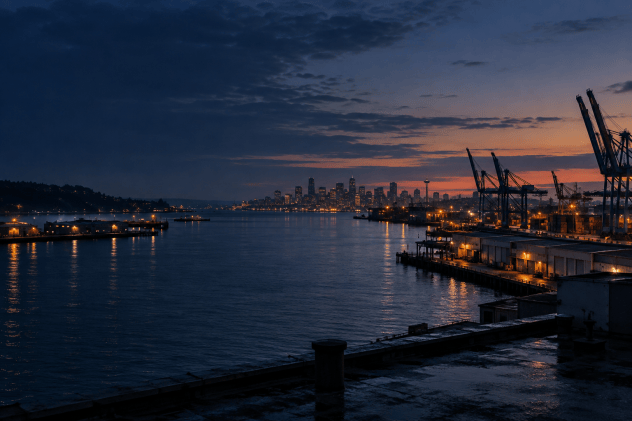
At the edge of the city, evening arrives twice. First it turns the warehouse windows gold. Then it slips beneath the cranes and across the water, erasing the far shore until only the lights remain.
The last ferry looks almost weightless from here: a small rectangle of warmth moving through an enormous blue room. On board, someone folds a newspaper. Someone else rests a forehead against the glass. The city is going home, but the waterfront is only changing its audience.
This is a fictional walk through a harbor town over one night. Its places, scenes, and activity index are invented; its invitation is simple. Stay a little longer. See what happens after the familiar view disappears.
01 / 8:17 P.M.
The blue hour
The promenade is still full of small negotiations: one more lap, one more photograph, one more minute before dinner. Bicycles tick as they cool beside a railing. A gull has claimed the best table outside the shuttered kiosk.
Across the channel, a crane turns so slowly that its movement is visible only if you stop looking for it. The ferry leaves a widening seam in the water. For a moment, every reflection tilts in the same direction.
By daylight, this place is a diagram of things: dock, road, warehouse, shore. At dusk, it becomes a diagram of attention. The bright doorway matters more than the building around it. The sound of a chain matters more than the boat you cannot see.
A cleaner begins at the far end of the boardwalk, pushing a wide broom toward the city. Behind her, the pavement catches the last color in the sky. The work is ordinary. The hour makes it luminous.
THE WATERFRONT, IN MOTION
A city changes shifts
A fictional activity index, from 0 (quiet) to 100 (busiest). Hover, tap, or select each row to explore the story behind the rhythm.
Evening promenade88 / 100
Midnight freight64 / 100
Pre-dawn harbor28 / 100
Demonstration data only. These values are invented narrative devices, not measurements or reporting.
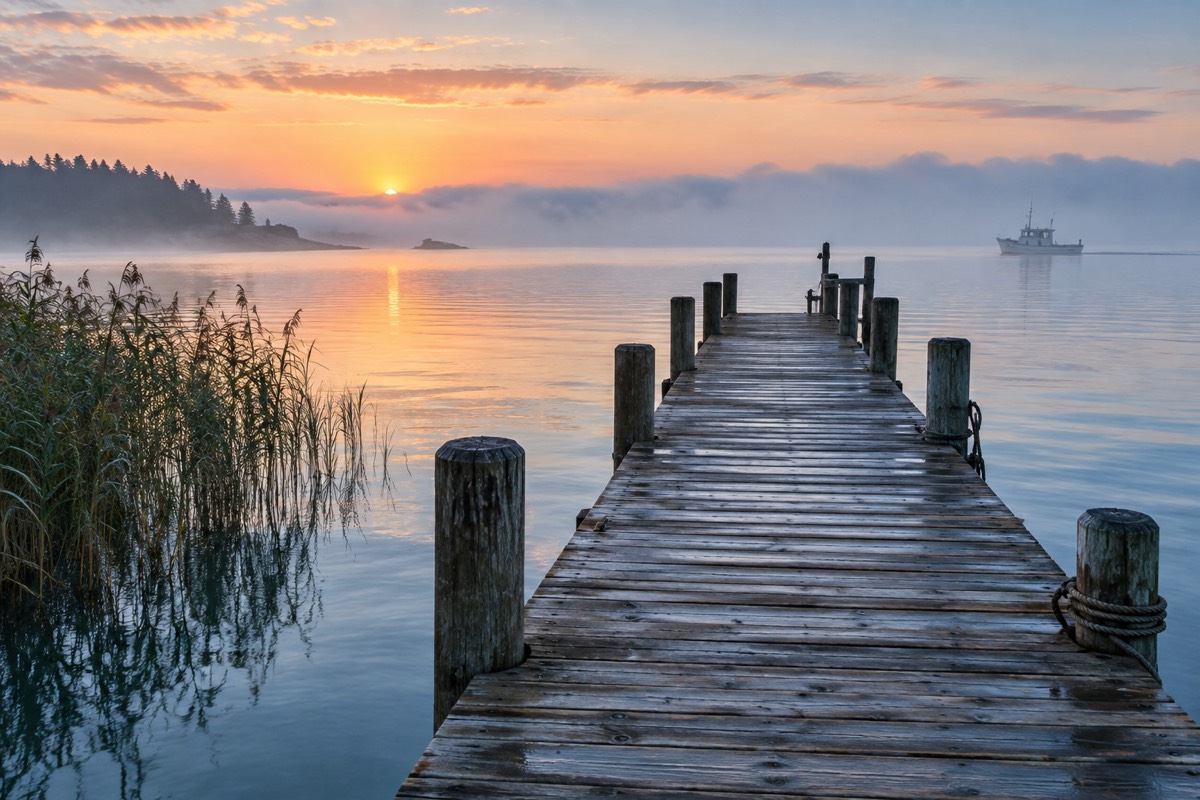
ADVERTISEMENT · FICTIONAL BRAND DEMO
Some mornings
are worth staying for.
Stillwater House · A slower kind of escape.
Sample creative only. No booking or tracking integration.
02 / 12:46 A.M.
The small hours
The public path ends at a chain-link gate. Beyond it, the harbor continues in a language of reversing signals, radio calls, and steel doors settling into their frames. A loading bay throws a clean white square onto the asphalt.
There is no grand reveal here, no secret city hiding inside the real one. There are people doing the next task. A driver checks a strap. A dispatcher moves a mug away from a keyboard. A mechanic pauses to listen before reaching for a tool.
From the road, each action seems isolated. Stay long enough and the connections appear. One truck makes room for another. A light switches on before a door opens. A boat turns toward a berth that has just become empty.
The daytime city advertises its destinations. The night city shows its dependencies. What arrives in the morning has already been handled, checked, carried, or repaired by someone whose shift began when ours ended.
Near the gate, a bench faces the black water. The city behind it has become a low, continuous hum. The bench is empty. For once, the view asks for nothing but time.
Not everything that
keeps a city moving
can be seen from shore.
A pause in the journey
FIRST LIGHT
And then,
the world returns.
03 / 5:38 A.M.
Before the first footsteps
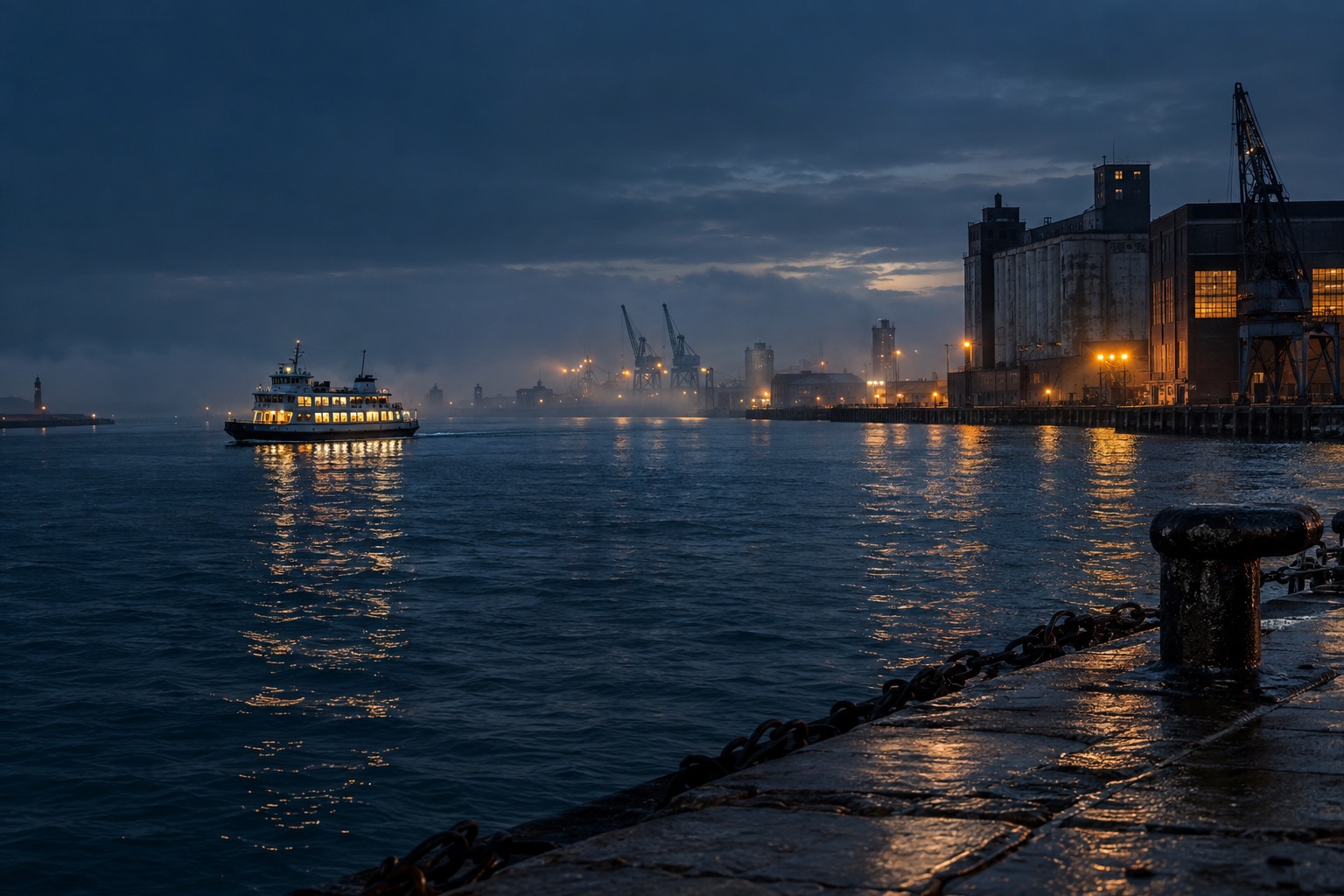
The return of color is almost imperceptible. Black water becomes slate. The pier separates from its reflection. A strip of pale sky appears where the far shore had been.
At the reed beds, the city sounds farther away. A small boat moves through the mist, leaving a line that closes behind it. The first walker arrives with a paper cup and stops at the end of the pier. There is nothing unusual about the gesture. That is what makes it feel like an ending.
Soon the waterfront will be busy explaining itself again: timetables, menus, signs, routes. For now, it is enough to watch the light reach the boards one by one.
The city has not been asleep. We have simply returned to it.
About this feature: an original fictional editorial demonstration. All scenes and data are invented. Images were generated with OpenAI ImageGen and are illustrations, not documentary photographs.